

Ambient IoT: What It Is, Where It Helps, and How Light Harvesting Fits Asset Tracking
Battery changes rarely make the project plan — until they do. For IT, facilities, and operations teams rolling out asset tags across offices, warehouses, or storage rooms, maintenance cost and downtime often decide whether a tracking system stays useful after year one. That is the practical problem Ambient IoT is trying to solve: keep devices connected with far less battery work, by drawing small amounts of power from the environment itself.
This note explains what Ambient IoT means in plain terms, where it is useful today, where it still falls short, how standards are moving, and how Star Green Media’s Light Harvesting IoT Sensor fits into workplace signage and asset-visibility projects.
What Ambient IoT is — and how it works
Ambient IoT refers to IoT devices that are battery-less, or that carry only tiny energy storage, and that run mainly by harvesting ambient energy. Common sources include radio-frequency (RF) fields, light (photovoltaic / PV cells), heat (thermal gradients), and vibration or motion. The harvested power is typically in the microwatt (µW) range — enough for sparse sensing and short wireless bursts, not for always-on high-bandwidth links.
Many Ambient IoT designs go further than simply “a sensor with a solar cell.” To stay within such a tight energy budget, devices often use backscatter: instead of generating a strong radio transmission themselves, they modulate (reflect / encode onto) an external carrier wave provided by a reader, gateway, or network infrastructure. Receive paths can also be simplified — for example, envelope detection instead of a full active radio receiver — so peak power stays extremely low.
This is related to classic passive UHF RFID, but the industry conversation has widened. Ambient IoT work now sits alongside cellular (3GPP), WLAN, and Bluetooth ecosystems, so inventory and sensing can, in some scenarios, become more continuous and less dependent on handheld readers alone. In short: same idea as passive tags — harvest energy, stay simple — but with a broader set of air interfaces and deployment patterns under study and early standardization.
A useful mental model for decision-makers:
- Energy in — light, RF, heat, or vibration at the tag location.
- Tiny store — optional capacitor or micro-storage to ride through short gaps.
- Sparse work — sense, ID, or status update when energy allows.
- Low-power radio path — often backscatter or ultra-low-power beaconing toward infrastructure that already has power.
If the energy path is weak or intermittent, the device simply does less — or pauses — until conditions improve. That trade-off is intentional, not a defect: Ambient IoT buys lower maintenance by accepting duty-cycled behaviour.
Uses — and honest limitations
Where it helps
Ambient IoT is most attractive when you need many endpoints, long life, and low touch:
- Warehouses and logistics — item, tote, or pallet identification and inventory checks without swapping coin cells at scale.
- Indoor asset tracking — equipment, archives, tools, and shared assets where tags should stay attached for years.
- Personal / high-volume asset visibility — scenarios where battery logistics would dominate opex if every tag needed periodic replacement.
- Indoor positioning and checkpoint flows — when infrastructure (gateways, access points, or specialized readers) can supply or interact with the energy and radio path.
- Workplace IoT alongside E-ink and sensors — combining lower-maintenance tags with room signage, door/contact sensors, and a shared dashboard for location, movement history, and alerts.
ITU-T’s technical report YSTR.Ambient IoT (January 2025) frames requirements and use cases along these lines — warehouses, logistics, personal asset tracking, and indoor positioning — while also calling out the engineering reality: energy paths, unstable harvested power, and simplified device architecture.
Where it still constrains you
Ambient IoT is not a drop-in replacement for every BLE battery tag or active tracker. Practical limits include:
- Unstable energy — lighting changes, RF coverage gaps, or shaded corners mean intermittent operation. Broadcasting or updates may pause until energy returns.
- Deployment complexity — you must plan the energy path as carefully as the network path: lux levels for light harvesting, reader/CW coverage for RF/backscatter designs, and realistic duty cycles.
- Simplified device architecture — ultra-low complexity caps data rate, on-device processing, and feature richness. Expect IDs, sparse telemetry, and status — not continuous HD video or heavy local analytics.
- Multi-protocol and ecosystem maturity — aligning tags, gateways, and backends across Bluetooth, WLAN, and cellular Ambient IoT directions is still evolving; multi-standard difficulty is a known challenge in industry analysis.
- Not “set and forget” everywhere — dark cabinets, sealed metal enclosures, or spaces with long lights-off periods need a different tag mix (battery BLE, RFID checkpoints, or hybrid designs).
For ops teams, the decision question is usually: Do we need continuous updates in all conditions, or is lower-maintenance, light-aware / energy-aware visibility enough for this asset class?
Future outlook — standards and ecosystem
Ambient IoT is moving from vendor-specific niches into mainstream standards work.
3GPP Release 19 includes Ambient IoT work aimed at ultra-low-complexity devices (often discussed as “device 1” class, on the order of ~1 µW peak), with backscatter device-to-reader (D2R) operation on an external continuous wave and simplified receive methods such as envelope detection. Early focus areas include indoor inventory and indoor command. Rel-19 leaves the exact energy-harvesting source unspecified — devices may harvest light, RF, or other ambient sources depending on product design — with more capable device classes expected in later releases (for example Rel-20 discussions).
In parallel, the Ambient IoT Alliance (founded February 2025; founding members include Atmosic, Infineon, Intel, PepsiCo, Qualcomm, VusionGroup, and Wiliot) is promoting an open, multi-standard ecosystem for batteryless / energy-harvesting IoT. Related directions include IEEE ambient-power communication work and paths in Bluetooth and 5G Advanced. The practical effect for buyers should be gradual: clearer interoperability stories, more gateway and infrastructure options, and less lock-in over time — not an overnight rip-and-replace of every existing RFID or BLE deployment.
For Hong Kong B2B teams planning 2026–2028 rollouts, a sensible stance is: pilot Ambient / light-harvesting tags where lighting and maintenance pain are clear, keep proven RFID/BLE where continuity or coverage demands it, and design the dashboard so mixed device types still look like one operational picture.
Star Green Media’s Light Harvesting IoT Sensor
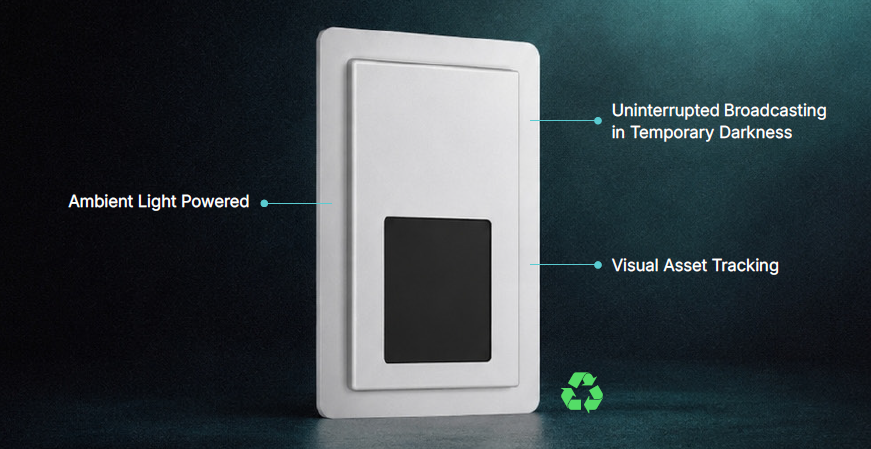
Light Harvesting IoT Sensor — ambient light powered for lower-maintenance asset tracking.
Star Green Media Technology Ltd. already includes an energy-harvesting IoT beacon — marketed as a Light Harvesting IoT Sensor — in its E-ink & IoT / Asset Tracking offering. The device harvests ambient light (and, where the hardware supports it, other environmental energy) so that day-to-day operation depends less on battery changes. As with other light-powered Ambient IoT designs, broadcasting may pause in temporary darkness; it is a good fit for asset tracking and inventory use cases that need lower maintenance in lit workplaces, corridors, open storage, and similar spaces.
That sensor sits inside a broader workplace stack:
- E-ink displays for room booking, doorplates, and asset labels
- Multi-brand IoT / RFID options (BLE tags, door/contact sensors, environmental sensors, handheld and fixed RFID)
- Gateways linking Bluetooth devices to Wi-Fi or Ethernet
- A custom dashboard (browser and mobile) for location, movement history, open records, alerts, and content updates — on the internet or a private intranet
In other words, light harvesting is not a standalone gadget story. It is one maintenance lever inside a system meant for workplace signage and asset visibility — choose harvesting where the environment supports it, and pair it with battery or RFID devices where it does not.
If you are mapping which assets can live on light-powered tags versus which still need battery BLE or RFID checkpoints, that planning step is usually where projects succeed or stall. We can walk through site lighting, duty-cycle expectations, and dashboard workflows before you commit to a device mix.
Planning workplace signage or asset visibility?
Discuss a project with Star Green Media — Tel (852) 3706 9588 · info@stargreenmedia.com · E-ink & IoT solutions.
Further reading
- ITU-T YSTR.Ambient IoT (2025-01) — Analysis on requirements and use cases of ambient power-enabled Internet of Things: itu.int publication
- 3GPP — Release 19 Ambient IoT: 3gpp.org/technologies/rel19-aiot
- Star Green Media — E-ink & IoT / asset visibility: stargreenmedia.com/services/e-ink-iot